



What a Fracture in a Diamond Actually Means
Diamond is the hardest natural material, which leads people to assume it cannot break. Hardness and toughness are separate properties, and diamond scores brilliantly on one and only moderately on the other. Understanding the fracture of a diamond starts with that distinction: hardness describes resistance to scratching, while toughness describes resistance to breaking under impact. A diamond will scratch anything, and a sharp knock in the wrong direction can still chip it. What matters for a buyer is where a break sits, how large it is, and whether anything has been done to hide it. That last point is where the real risk lives, and it is worth understanding before you look at fracture filling diamonds or any stone that may have been treated.
The vocabulary
Three terms get used loosely and mean different things.
A cleavage follows the crystal’s internal planes. Diamond has perfect cleavage in four directions, which is exactly how cutters split rough, and it is why a well-placed impact can do damage that seems disproportionate to the force.
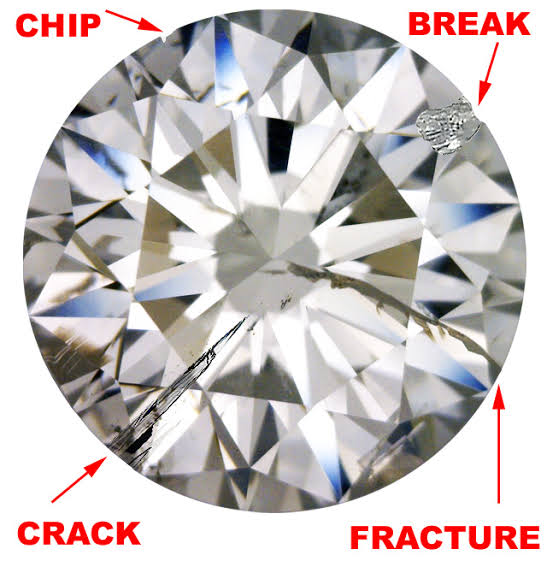
A fracture is a break that does not follow those planes, usually irregular in shape.
A feather is the trade term for either, describing the whitish, wispy appearance these breaks take on when light catches them.
When a break actually matters
Most feathers are cosmetic and entirely stable. A small one sitting well inside the stone has survived cutting, setting, and however many decades of wear already, and it will likely survive many more.
The ones that warrant attention share three characteristics: they are large relative to the stone, they reach the surface, and they sit somewhere exposed, typically near the girdle or along a crown edge. A surface-reaching feather at the girdle is the classic durability concern, because that is where setting pressure and knocks concentrate.
Ask a jeweler to show you the location under magnification rather than relying on a clarity grade alone. Two stones with the same grade can carry very different risk profiles.
What filling does
Fracture filling was developed in the early 1980s by Israeli gemologist Zvi Yehuda. Molten glass, typically lead-based, is injected under pressure into surface-reaching fractures. The filler has a refractive index of roughly 2.42, almost exactly matching diamond’s 2.417, so light passes through the filled break with very little disturbance and the feather becomes close to invisible.
The visual improvement is substantial. A stone that would grade SI2 or I1 untreated can present as VS2 once filled.
The treatment is not permanent, and that is the whole problem. Heat degrades it. So do ultrasonic cleaning, steam cleaning, ultraviolet exposure over time, and certain chemicals, including the acid baths used in the trade to clean stones. If the filler is damaged or driven out, the original fracture reappears, sometimes looking worse than it did before treatment.
For this reason GIA will not issue a grading report for a fracture-filled diamond. It issues an identification report confirming the stone is diamond and that it has been filled, and nothing more.
How it is detected
The tell is the flash effect: a distinct flash of color visible along the plane of the filled break when the stone is tilted, produced by the small mismatch in light dispersion between diamond and the filling glass. The classic form shows one color under darkfield lighting and its complement under brightfield, such as pink and green, and multicolored rainbow flashes appear when the fracture is viewed nearly edge-on. Cloudy or milky areas along the break are a supporting sign.
One genuine caution: the natural iridescence of an untreated fracture can be mistaken for the flash effect. This is a job for a gemologist, not for a hopeful ten minutes with a loupe.
Why estate buyers should care most
The specific danger with older jewelry is routine repair. A bench jeweler retipping a prong or sizing a shank uses a torch, and if the stone is filled and nobody knew, the filler can be destroyed during a job that was supposed to be maintenance. The owner gets the ring back with a visible fracture that was not there before.
Disclosure is not optional. Under the FTC Jewelry Guides, a treatment must be disclosed when it is not permanent, requires special care, or materially affects value. Filling meets all three. Ask directly, in writing, and ask a bench jeweler to check before any work involving heat.
For pieces examined and documented before they are offered, browse the collection at Gesner Estate Jewelry, where each item is hand selected and evaluated. A fracture disclosed is a manageable fact. A fracture concealed is a problem waiting for a torch.