



Weak airflow from a distant supply register can leave one room consistently warmer or cooler than the rest of a home. When the central HVAC equipment is operating correctly but a particular duct run needs additional airflow support, an inline booster fan may help move conditioned air through that section. The fan must be properly selected, positioned, and installed to suit the duct system and the specific comfort problem.
What Is an Inline Duct Fan?
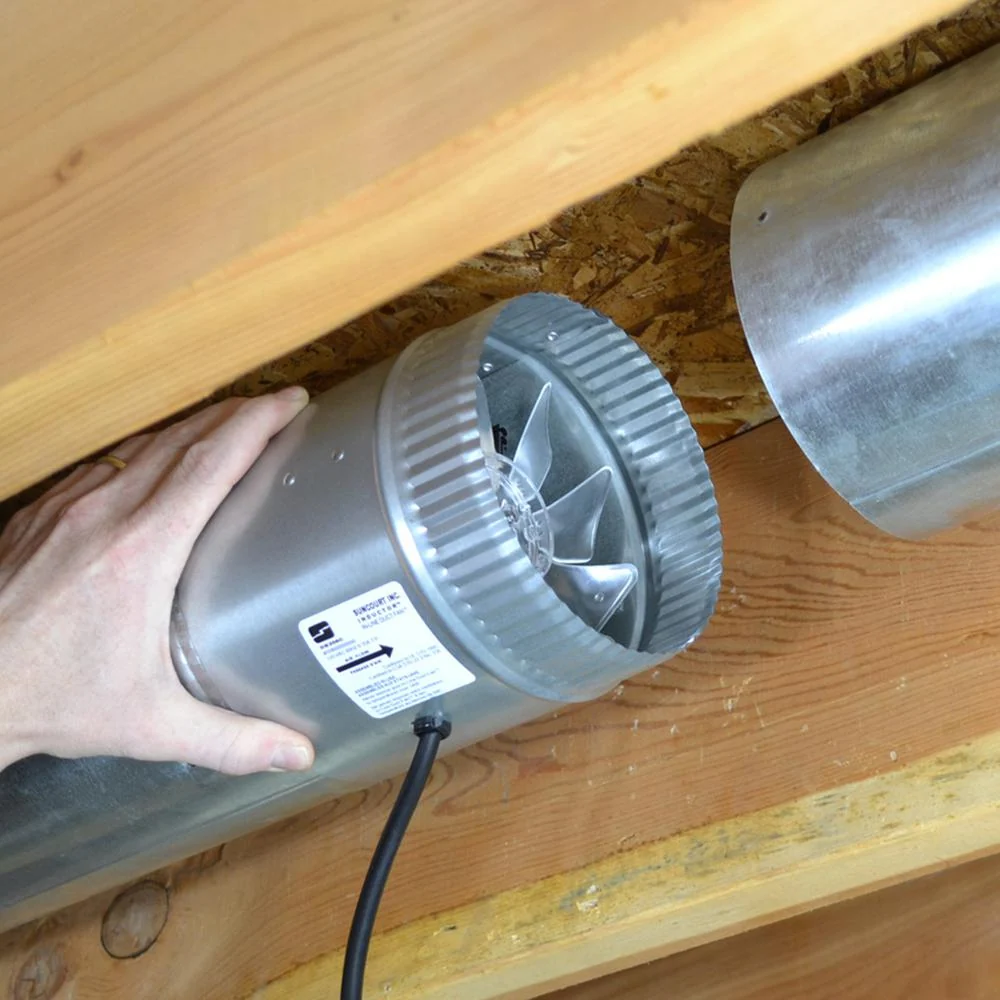
An inline duct fan is installed within a section of ductwork rather than at the supply register. Its rotating blades help move air along the duct toward the intended room or ventilation point.
Axial models move air in a direction parallel to the fan shaft. Their compact shape allows them to fit inside compatible round ducts, making them suitable for applications where installation space is limited.
The fan supports airflow already present in the duct. It does not produce heated or cooled air, and it cannot replace the blower inside an HVAC system. Its purpose is to assist air movement through a selected duct run.
Why Does Airflow Weaken Along a Duct Run?
Air encounters resistance as it travels through ductwork. Longer runs generally create more resistance than short, direct paths. Bends, fittings, duct transitions, and rough interior surfaces can reduce the amount of air that reaches the end of a branch.
Additional causes of weak airflow include:
- An undersized duct
- Loose or disconnected joints
- Crushed flexible duct
- Excessive bends
- Air leakage
- Closed balancing dampers
- Dirty filters
- Blocked supply registers
- Obstructed return grilles
- Improper system balancing
Some of these conditions require repair rather than added fan power. A disconnected duct, for example, should be reconnected and sealed. Adding a fan without correcting the leak would waste conditioned air and may fail to improve comfort.
When Might an Inline Fan Be Useful?
An inline fan may be considered when a specific duct branch receives airflow but does not deliver enough air to the connected room. This situation sometimes occurs in bedrooms, additions, finished basements, workshops, and spaces located far from the air handler.
It may also be useful for moving air between selected areas or supporting certain ventilation applications, provided the fan is approved for the intended use.
Common residential situations include:
- A second-floor room served by a long duct
- An addition connected to existing ductwork
- A home office with a greater cooling load
- A room above an unconditioned garage
- A space affected by afternoon sun
- A branch that loses airflow after several bends
The fan should not be treated as the first response to every temperature difference. Room comfort is also affected by insulation, windows, air leakage, return-air pathways, and equipment capacity.
What Should Be Checked Before Installation?
Begin by confirming that the HVAC system is operating normally. Inspect the air filter, supply register, return grille, accessible ductwork, and balancing damper. Contractors may also measure airflow and static pressure to determine whether the issue is limited to one branch.
If weak airflow affects several rooms, the cause could involve the central blower, evaporator coil, return system, overall duct design, or equipment sizing. Adding several booster fans may interfere with system balance without correcting the main fault.
The building envelope should also be considered. A room with poor insulation or major air leakage may remain uncomfortable even after airflow increases. Correcting those conditions may reduce the room’s heating or cooling demand.
How Should an Inline Fan Be Selected?
Duct diameter is a primary selection factor. The fan must match the duct size unless approved transitions are part of the installation plan. Contractors should also review airflow ratings, operating temperature, electrical requirements, control options, and installation orientation.
Noise is another consideration. Because the fan sits inside the duct, sound may travel toward the occupied room. Proper placement and suitable speed selection can help limit disruption in bedrooms, offices, and other quiet areas.
Other factors to compare include:
- Fan dimensions
- Airflow direction
- Speed settings
- Motor design
- Power consumption
- Control compatibility
- Mounting requirements
- Service access
- Manufacturer usage restrictions
A fan should be selected for its stated application. A general in-line duct fan should not automatically be used for clothes dryer exhaust, radon mitigation, grease-laden air, or other specialized applications.
What Controls Can Be Used?
Control methods vary by model and application. Some fans operate whenever the central HVAC blower runs. Others may be connected to a switch, speed control, thermostat, or compatible automated control.
Coordinating fan operation with the central system can prevent the unit from running when no conditioned air is available. The chosen control must match the fan’s electrical specifications and installation instructions.
Any wiring should follow applicable electrical requirements. When work exceeds the homeowner’s experience, a qualified installer should complete the electrical connection.
Why Do Placement and Access Matter?
The fan should be installed in a duct section that allows air to enter and leave without immediate obstruction. Sharp bends located directly before or after the fan can affect performance and increase noise.
The unit must remain accessible for inspection, cleaning, repair, or replacement. Concealing it permanently behind drywall may create problems when service is required. Installers should also support the fan and nearby ductwork so vibration is not transferred to framing or finished surfaces.
After installation, test the fan with the complete HVAC system running. Confirm airflow at the register, listen for unusual noise, and make sure other rooms continue to receive suitable airflow.
Address the Cause Before Adding Airflow Support
An inline duct fan can help improve air movement through a selected branch when long runs or building layouts create a localized comfort problem. The best results come from inspecting the system first, choosing the correct fan size, and maintaining safe service access. Visit Suncourt to compare axial in-line duct fans and find an option suited to the duct size, control method, and intended application.