


BLS Certification Explained: What Healthcare Providers Learn That Standard CPR Courses Skip
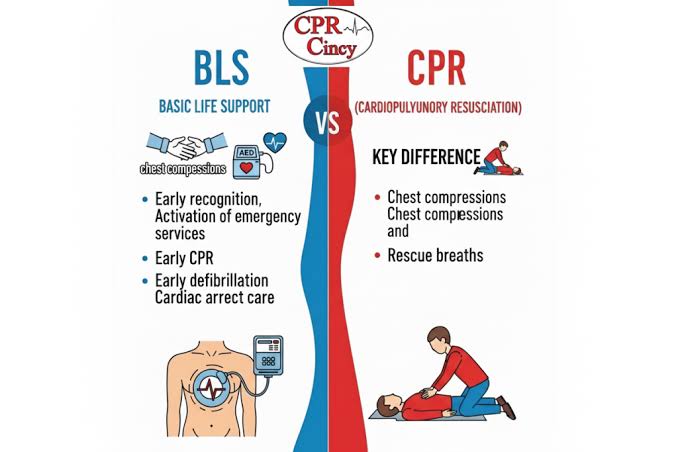
Most people who complete a community CPR class leave with a genuinely useful skill set. They can recognize cardiac arrest, call for help, push hard and fast on the center of the chest, and operate an automated external defibrillator. That is enough to save a life in a grocery store or a living room. It is not enough for a clinical environment, which is why BLS certification exists as a separate credential built specifically for people who respond to emergencies as part of their job rather than by chance.
The distinction matters more than the shared vocabulary suggests. Both courses teach chest compressions. Only one prepares you to function inside a resuscitation team with equipment, colleagues, and accountability.
What BLS Adds to a Standard CPR Course
Basic Life Support training assumes you will not be alone and that you will have tools available. That assumption changes almost everything about the curriculum.
Two-rescuer sequences. Compression-to-ventilation ratios shift when a second trained responder is present, particularly for pediatric and infant patients. Provider-level courses drill these variations until the switch is automatic.
Ventilation with a bag-mask device. Delivering effective breaths with a bag-mask is a genuine psychomotor skill. Poor seal technique and excessive volume are common, and both reduce the effectiveness of the resuscitation. Community courses rarely cover this at all.
Team dynamics and closed-loop communication. A resuscitation with four people in the room can fail on coordination alone. BLS teaches role assignment, clear verbal handoffs, and the practice of confirming instructions out loud so nothing is assumed.
Compression quality metrics. Providers are trained to minimize interruptions, rotate compressors on a fixed interval to counter fatigue, and pay attention to the proportion of time compressions are actually being delivered. These are measurable performance standards, not general guidance.
Pulse checks and airway management. Healthcare providers are expected to assess for a pulse within a defined time window and to manage rescue breathing for patients who have a pulse but are not breathing adequately.
Who Is Expected to Hold It
Nurses, physicians, respiratory therapists, paramedics, dental staff, medical assistants, radiology technologists, and pharmacy staff in clinical settings are the most common groups. Nursing and allied health students are usually required to certify before their first clinical placement, and many programs will not permit a student on the floor without current documentation.
Beyond direct clinical roles, some fitness professionals, athletic trainers, and staff at facilities with a medical director are asked to hold provider-level certification rather than the community version. If you are unsure which applies to you, the answer comes from your employer, program coordinator, or licensing body, not from the training provider.
Choosing a Format That Your Employer Will Accept
Provider-level training is commonly offered in a blended format, where the cognitive portion is completed online and a hands-on skills session is arranged separately. The online segment covers the science, the algorithms, and the decision points. The in-person component verifies that you can actually perform compressions to depth, seal a bag-mask, and operate the equipment.
Some employers and programs accept fully online completion. Many clinical settings require documented hands-on verification. Confirm which one applies before you enroll, because that single question determines whether the certification you purchase will be accepted when you submit it.
Mistakes That Cost People Time and Money
Three errors account for most of the problems.
The first is buying a community CPR course when a provider-level course was required. The titles look similar enough that it happens regularly, and the fix is a second purchase.
The second is skipping the acceptance check. Send the specific course details to whoever reviews your documentation and get confirmation in writing before paying.
The third is letting certification lapse. Renewal is straightforward when done on schedule and becomes an administrative problem when it is not, especially if a shift or clinical rotation depends on current status. Set a calendar reminder ninety days before expiration.
Staying Competent Between Renewals
Certification is typically valid for two years, and skill retention starts declining well before that window closes. Compression depth and rate are the first things to degrade, followed by mask seal technique.
Brief, frequent practice works better than a single refresher. Rehearse the sequence out loud with a colleague. Confirm where the nearest crash cart and defibrillator are on every unit you work. Spend two minutes on a manikin when one is available and pay attention to how quickly fatigue sets in, because that experience is what makes rotation intervals feel necessary rather than arbitrary.
Getting Certified
Provider-level training is not simply a longer version of a community class. It is a different course for a different job, built around teams, equipment, and measurable performance.
If you are ready to certify or renew, Simple CPR offers healthcare provider training designed around clinical scheduling realities. Visit the site to review formats and confirm the option that matches your requirements.